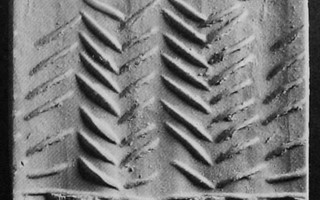
Three rows of herringbone patterns
| Kategória | Cylinder Seals |
| Description of the seal image | The geometric scene framed by a line border at the top and bottom depicts three rows of herringbone patterns. |
| Figures, motifs/symbols |
- borderlines (2): line borders at the top and bottom - geometric pattern: three rows of herringbone patterns |
| Subcategory | bead cylinder seal |
| Collection | University of Pennsylvania Museum of Archaeology and Anthropology |
| Museum number | HAS 60-516a; UM 61-5-86a; |
| Culture | Iranian, peripheral |
| Provenance | found at Tepe Hasanlu, southwest Azerbaijan, northwest Iran, during the excavations conducted by The University Museum of the University of Pennsylvania, The Metropolitan Museum of Art (from 1959), and the Archaeological Service of Iran, under the general direction of Robert H. Dyson, Jr, between 1956-1977 |
| First occurence | between 1956-1977 (excavations) |
| Archaeological context | residential: Tepe Hasanlu, Burned Building II, Room 2, second-story collapse (found together with two spindle-shaped faience beads (HAS 60-516) |
| Registration number | HAS 60-516a |
| Dimensions (mm): height, diameter | h: 36.7, d: 15 |
| Material and features | unglazed composite material |
| Style | sintered quartz |
| Scene | geometric |
| Transliteration |
N/A |
| Bibliography |
Marcus 1996, 108 no. 37 and pl 15. Marcus, M.I.: Emblems of Identity and Prestige: The Seals and Sealings from Hasanlu, Iran: Commentary and Catalog. (University Museum Monograph 84. Hasanlu Special Studies 3) Philadelphia, 1996. |