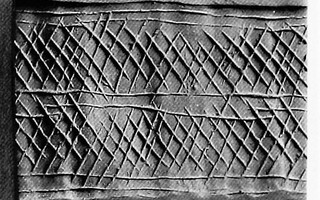
Crosshatch pattern in two registers
| Kategória | Cylinder Seals |
| Description of the seal image | The scene framed by double line border at the top and bottom is separated into two registers by a double ruling in the middle. The registers show crosshatch patterns. |
| Figures, motifs/symbols |
- borderlines (2): double line borders at the top and bottom - geometric pattern: crosshatch pattern |
| Subcategory | bead cylinder seal |
| Collection | University of Pennsylvania Museum of Archaeology and Anthropology |
| Museum number | HAS 64-826; UM 65-31-254; |
| Culture | Iranian, peripheral |
| Provenance | found at Tepe Hasanlu, southwest Azerbaijan, northwest Iran, during the excavations conducted by The University Museum of the University of Pennsylvania, The Metropolitan Museum of Art (from 1959), and the Archaeological Service of Iran, under the general direction of Robert H. Dyson, Jr, between 1956-1977 |
| First occurence | between 1956-1977 (excavations) |
| Archaeological context | residential: Tepe Hasanlu, Burned Building II, Room 7, second-story collapse (found together with Egyptian blue beads [HAS 64-827]) |
| Registration number | HAS 64-826 |
| Dimensions (mm): height, diameter | h: 32.3, d: 10.3 (slightly barrel-shaped) |
| Material and features | possibly sintered quartz; |
| Style | sintered quartz |
| Scene | geometric |
| Transliteration |
N/A |
| Bibliography |
Marcus 1996, 107 no. 34 and pl. 14. Marcus, M.I.: Emblems of Identity and Prestige: The Seals and Sealings from Hasanlu, Iran: Commentary and Catalog. (University Museum Monograph 84. Hasanlu Special Studies 3) Philadelphia, 1996. |